On September 19th, a federal court in Pennsylvania held that a wall collapse was not fortuitous because the insureds knew that the wall was unstable and likely to fall and yet took no steps to correct the problem. No one could say the loss was certain to happen, but the court effectively held that the insureds’ inaction was enough to make the collapse non-fortuitous given the likelihood that the wall would fail if it wasn’t repaired or braced. The decision is Fry v. Phoenix Ins. Co., 2014 WL 4662481, 2014 U.S. Dist. LEXIS 131504 (E.D.Pa., Sept. 19, 2014).
 The Frys owned a home in Fleetwood, Pennsylvania. The house was a wood-frame structure with a stone veneer, and they noticed that the veneer was bulging in 2003. An engineering report that they commissioned at the time attributed the problem to “an insufficient number of veneer wall ties and fasteners,” and the Frys paid $22,000 to have the exterior wall repaired.
As of 2011, the policyholders were insured by Phoenix Insurance Company, and the contract of insurance extended coverage to the peril of collapse, which was defined as “an abrupt falling down or caving in” of a portion of the structure. In July of that year, the Frys made claim for bulging of the veneer’s exterior after a storm, and both the policyholders and Phoenix then secured expert reports. The insured’s expert attributed the movement to the fact that “there is not a good connection between the stone veneer and the framed wall,” and he recommended repair and temporary bracing from outside if repairs could not be done “within the next couple months.” The carrier’s expert ascribed the problem to “inadequate anchorage to the wood-framing” as well and also recommended repair and temporary bracing until that could be accomplished. The insurer denied liability because the bulging was “not sudden and accidental” in nature. Read more ›
 The Brancos’ home was damaged by a sinkhole in April of 2010, and they made claim under a homeowner’s policy issued by Homewise Preferred Insurance Company. The insurer denied liability, asserting that what had happened did not qualify as a “sinkhole loss” as defined, and the Brancos brought suit. Homewise was subsequently declared insolvent, and Mr. and Mrs. Branco filed an amended complaint substituting the Florida Insurance Guaranty Association as defendant.
 The case involved sinkhole damage to a piece of property owned by Cannon Ranch Partners, Inc. The property was insured by Cincinnati Insurance Company, and the contract of insurance included coverage for sinkholes. The dispute involved the necessary scope of repair. Cincinnati’s two consultants determined that grouting was all that was needed to restore the structure to its pre-sinkhole state, but Cannon Ranch’s consultant opined that underpinning was also needed, and the policyholder entered into a contract to have that done. Cincinnati refused to sign off on the work, however, and it made a demand for appraisal instead.
 The case arose after the Office of Thrift Supervision closed Vantus Bank and appointed the FDIC as its receiver. The FDIC then filed suit against the bank’s former officers and directors, alleging gross negligence and breach of fiduciary duties. Progressive Casualty Insurance Company, which had issued a D&O policy to the bank, responded by filing a declaratory judgment action of its own, asserting that there was no coverage for the FDIC’s claims under its contract of insurance.
 The Curries were the owners of a home in Langhorne, Pennsylvania. When Superstorm Sandy struck on October 29, 2012, the structure took a direct hit from a tree on the property. The insurer, State Farm Fire & Casualty Company, conducted an inspection and then tendered its repair estimate to the policyholders together with a check for $56,940.54 – the actual cash value of the estimate less the policy’s deductible. The Curries responded by submitting their own repair estimate in the amount of $363,804.98. State Farm then conducted a new inspection and made a supplemental payment of $9,502.09.
 Effective March 16, 2010, Colony Insurance Company issued a commercial property policy providing $4.5 million in coverage for a vacant, 95,000 sq. ft. building in Montezuma, Georgia. In light of the vacancy, the insurer insisted that the policy include a protective safeguards endorsement requiring that the policyholders maintain an automatic sprinkler system, fire extinguishers, and functioning utilities and reciting that Colony would “not pay for loss or damage caused or resulting from fire if, prior to the fire, [the insureds] [f]ailed to maintain any protective safeguard . . . in complete working order.” The policyholders’ application for coverage also recited that the utilities in the building were on. When the insurer had the structure inspected in early April, however, the utilities were all found to be shut off.
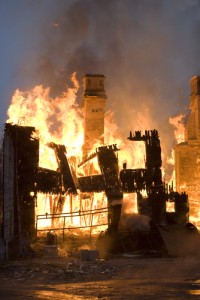 The case arose after Lewayne Greene moved into a retirement community, vacating her home in Irving, Texas and placing the structure on the market. She notified her insurer of the move, but she did not purchase an endorsement offered by the carrier, Farmers Insurance Exchange, that would covered an extended vacancy. Four months later, fire from a neighboring house spread to her home and damaged it. Farmers denied the subsequent insurance claim because the structure had been vacant for over sixty days, and the policyholder brought suit. She prevailed in the trial court, but the Court of Appeals reversed and rendered judgment for Farmers. On appeal, a unanimous Texas Supreme Court affirmed.
 Plaintiff Hamilton Properties acquired the Dallas Plaza Hotel in 2006 and mothballed the structure in February of 2009. The hotel was insured by American Insurance Company (AIC) from February through September of 2009. In 2012, the policyholder notified AIC that it was making claim for roof and water damage allegedly sustained during a July 8, 2009 storm that dumped ping-pong sized hailstones on the city. After investigating the loss, the insured denied liability, and Hamilton Properties brought suit.