Introduction
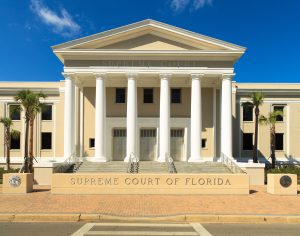
At least two Florida appellate courts have directly contradicted each other on an increasingly-important question facing Floridians and the insurance industry. The question is as follows: “Are insurance provisions valid which condition the validity of third-party benefits assignments upon the written consent of all insureds and named property mortgagees?” The answer to this question is important because Floridian policyholders often assign their insurance rights to construction companies post-loss to receive services without up-front payment. The Florida Supreme Court was recently asked to answer this important question, and it is likely to weigh in, although it has not yet formally decided to do so.
Public Policy
Public policy concerns animate assignment-of-benefits (“AOB”) legal disputes in Florida. Florida construction companies and policy-holder attorneys argue that AOB is good for policy-holders because it allows them to immediately repair damaged property. However, insurance advocates contend that certain AOB limitations are necessary to mitigate abuse, fraud, needless litigation, and ultimately to minimize insurance premiums to policyholders.
A 2016 Insurance Journal article explained that unscrupulous contractors often obtain AOBs, submit inflated repair-cost claims to insurers, and then work closely with “highly litigious” trial groups to sue the insurers for denying these claims, whether in whole or in part. Amy O’Connor, Florida Fights Back Against Assignment of Benefits Abuse, Insurance Journal (Feb. 8, 2016). A 2018 article indicates that as a result, the number of AOB lawsuits in Florida has been “spiraling out of control,” from 405 lawsuits in 2007 to 28,000 lawsuits in 2016—a “68-fold increase.” Liam Sigaud, Florida Insurance Abuse Spiraling Out of Control, Pensacola News Journal (March 14, 2018).
Thus, the legal AOB controversy currently taking place in Florida is the tip of a much larger public policy iceberg. Because of the breadth and depth of the public policy considerations at play, even those Florida courts which have taken a side have done so on purely legal grounds, recognizing that the complex policy considerations are best addressed by the Florida Legislature. Unfortunately, the Florida Legislature has repeatedly tried yet been unable to resolve the present dispute. Read more ›

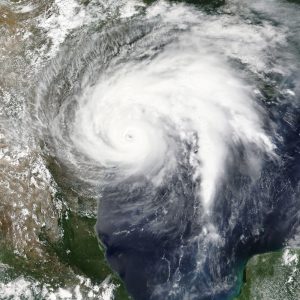 While Hurricane Ike made landfall in Texas almost ten years ago, the resulting litigation is alive and well as evidenced by the recent decision in Texas Windstorm Insurance Association v. Dickinson Independent School District, 14-16-00474-CV, 2018 WL 2436924 (Tex. App.—Houston [14th Dist.] May 31, 2018, no pet. h.). In that case, Houston’s Fourteenth District Court of Appeals addressed whether an unpaid appraisal award established an insurance company’s liability under a named-peril insurance policy as a matter of law. In analyzing and applying the Supreme Court of Texas’s decision in State Farm Lloyds v. Johnson, 290 S.W.3d 886 (Tex. 2009), the court held that the appraisal award, by itself, did not conclusively establish liability for purposes of the policyholder’s motion for summary judgment as to causation and damages.
 This is a question the Colorado Supreme Court is set to resolve after recently granting Owners Insurance Company’s petition for writ of certiorari in Owners Insurance Company v. Dakota Station II Condominium Association, Inc., 2018 WL 948601 (Col. Feb. 20, 2018).
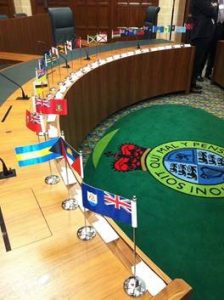 In a rare foray into insurance law, London’s Privy Council considered the interpretation of a Contractors’ All Risk (CAR) policy in Sun Alliance (Bahamas) Ltd v Scandi Enterprises Ltd (Bahamas),
 A not uncommon scenario: after examining the charred debris of a property fire, investigators note that the building’s alarm failed to sound and automatic sprinkler system similarly failed to activate because neither had been inspected or maintained for over a year. The policy that insured the property conditioned coverage on the protective safeguards’ maintenance and functionality. The insured’s failure to satisfy these conditions bars coverage for the loss.
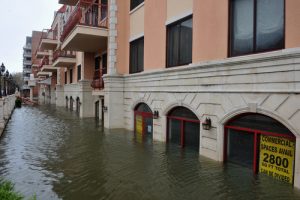 Cozen O’Connor attorneys Thomas McKay III, Richard Mackowsky, Charles Jesuit, and Melissa Brill recently secured summary judgment from the United States District Court for the Eastern District of New York in favor of Great Northern Insurance Company on claims asserted by Madelaine Chocolate Novelties seeking $49.5 million in coverage for Hurricane Sandy-related losses under an “all risk” property and business interruption policy.
 Texas has finally enacted statutory reforms specifically designed to combat abusive insurance litigation. Enacted primarily in response to hailstorm lawsuits, the scope of the reforms are much broader. Effective September 1, 2017, Section 542A of the Texas Insurance Code governs all lawsuits arising out of insurance claims where the damage was caused, either directly or indirectly, by the weather or other “forces of nature.”


 In February, the Nebraska Supreme Court held that it is acceptable for insurance companies to depreciate labor costs when determining the actual cash value (ACV) of damaged property, even when the insurance policy does not define “actual cash value” or “depreciation.” See Henn v. American Family Mutual Insurance Co., 295 Neb. 859 (Neb. 2017). Writing for the Nebraska Supreme Court, Chief Justice Michael Heavican concluded that all relevant facts and evidence should be used to calculate ACV, and both materials and labor constitute relevant facts to consider when establishing the value of property prior to the loss.
 Are an insurer’s attorney’s fee bills discoverable in first party claims? In In re Nat’l Lloyds Ins. Co., 2017 Tex. LEXIS 522 (Tex. 2017), the Texas Supreme Court considered this question in a hail MDL dispute and answered “No” in a lengthy opinion. The opinion is the latest development in a long-running dispute over “storm chaser” claims that recently gave rise to another round of tort reform in the Texas legislature.