In most jurisdictions, underlying coverage issues must be resolved prior to invoking appraisal in a first-party property claim. The question of what constitutes a coverage issue (typically reserved for a court’s judicial determination) and what constitutes a damage issue (appropriate for an appraisal panel’s consideration), however, is not always readily apparent. A routine subject of this particular appraisal debate is whether causation is a coverage or a damages inquiry, and recent decisions under Florida, Georgia and Texas law are evident of two things: (1) the determination of the issue is, in large part, factually dependent; but (2) the debate is far from over.
In a recent appellate decision, Citizens Prop. Ins. Corp. v. Denetrescu, 2014 WL 1225124, — So.3d — (Fla. 4th DCA, March 26, 2014), Florida’s Fourth District Court of Appeal found that causation is a coverage question and only for the court’s consideration when the underlying facts include a complete coverage denial by the insurer. There, the insurer issued such a denial for wind and rain damage to a roof and the resulting contents damage based on policy exclusions for wear and tear, neglect, and pre-existing damage, as well as on the policyholder’s non-compliance with post-loss duties under the contract of insurance. The policyholder filed a lawsuit challenging the insurer’s denial and filed a motion to compel appraisal during the course of discovery. In the lower court’s order granting the policyholder’s motion, the court included the its coverage determination – namely that “water leaks are covered under the policy” and that the insurer’s “affirmative defenses dealing with specific exclusions under the policy are appropriate for appraisal as the defenses deal with the causation of the damages.”
 On appeal, the District Court of Appeal completely rejected the lower court’s use of an order compelling an appraisal as a vehicle to make coverage determinations, finding that it was procedurally improper and violated due process. The court was clear that, under Florida law, such coverage determinations are only appropriate when based on competent evidence reviewed through either summary adjudication or at trial. Additionally, and in light of the insurer’s complete denial of the damage at issue, the District Court of Appeal held that a judicial determination on all coverage issues, including causation, must first be made by the court. In reaching its ruling, the court cited a Florida Supreme Court decision, Johnson v. National Mut. Ins. Co., 828 So.2d 1021, 1022 (Fla. 2002), which held that “causation is a coverage question for the court when an insurer wholly denies that there is a covered loss and an amount-of-loss question for the appraisal panel when an insurer admits that there is covered loss, the amount of which is disputed.”
In Texas, the United States District Court for the Southern District also addressed whether causation could fall within the permissible scope of appraisal under in its January 30, 2014 decision in United Neurology, P.A. v. Hartford Lloyd’s Ins. Co., 2014 WL 345666, — F. Supp.2d — (S.D. Tex. January 30, 2014) concluding that causation was within the appraisal panel’s authority where a partial denial of coverage was at issue. The United Neurology case arose from a policyholder’s claim for a complete roofing system replacement and payment for interior damage and loss of income associated with two rental properties following Hurricane Ike. Due to the insurer’s finding that a substantial portion of the damage was not caused by the hurricane – but rather from expressly excluded causes of loss, including pre-existing wear and tear and post-loss neglect – the insurer issued a partial denial and invoked the appraisal clause. Read more ›
About The Author


 On February 16, 2006, State Farm submitted a quarterly bill for the two policies, payable on or before April 6th. No payment was forthcoming. On March 22nd, the insurer sent a notice of cancellation, reciting that the two contracts of insurance would be cancelled on April 6th if Brown failed to pay the full amount due by that date. It was uncontested that no payment was made. Read more ›
 Richard Palkimas was insured under a homeowner’s policy issued by State Farm Fire & Casualty Company, and he sustained two losses. The first occurred in September 2006, “when workers negligently used a toilet that had been blocked off resulting in a buildup of sewage, and the breaking and rupturing of a sanitary pipe, as well as the spreading of sewage and fecal matter throughout the home.” Then in January of the following year, the policyholder discovered that “freezing temperatures caused substantial damage to [his] home, including fracturing of the plaster walls and building structure.”
 The policyholder owned an apartment complex that was insured by Dryden Mutual. The structure was damaged when waste water inundated the first floor, entering the units through toilets, bathtubs, and drains. The insurer denied liability, contending that coverage was barred by two “Water Damage” exclusions. The first recited that loss caused by “water which backs up through sewers and drains” was excluded, while the second barred coverage for “loss caused by repeated or continuous discharge, or leakage of liquids or steam from within a plumbing … system.” The second of these exclusions, however, went on to state that Dryden Mutual would pay for “loss caused by the accidental leakage, overflow or discharge of liquids or steam from a plumbing … system.”
 In Mirarchi, a fire damaged the insured’s property. The insurer paid the entire undisputed amount, and the parties proceed to appraisal on the remainder of the claim. An umpire entered an award close to the amount sought by the policyholder, and the carrier paid. Thereafter, however, the insured filed an action against the insurance company in federal court, asserting that the insurer had delayed payment in bad faith, and he requested discovery of the company’s reserve information. Seneca Specialty refused to provide the requested information, and the district court held that it was not obligated to so so. The trial court subsequently dismissed the bad faith claims in their entirety, noting that the insurer had paid the undisputed amount despite the lack of any contractual or legal obligation to do so and further that the insurer, in valuing the claim lower than the appraisal award, had relied on reasonable expert opinions.
  TRIA is activated once an event has been certified as an “act of terrorism” by the Secretaries of the Treasury and the Departments of State and Homeland Security. There is presently a $27.5 billion annual aggregate retention level, meaning that industry-wide commercial and worker’s compensation claims from a terrorist attack must exceed $27.5 billion before TRIA kicks in. The statute also has an 85/15 co-pay; above $27.5 billion, the federal government pays 85% of the loss and the insurance industry pays the remaining 15% up to a cap of $100 billion. Finally, each individual insurance company has a deductible that it must fund equal to 20% of its total property and casualty insurance premiums.
 In
In 

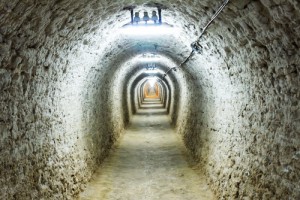 Lyons notified Lexington of the water inflow in July 2010, after it had already spent $2.5 million on the problem. The insured sought coverage under six Lexington policies of “all risk” property insurance issued between March 2004 and April 2010. Suit was filed in the Spring of 2011 after Lexington refused to commit to reimbursement. The sworn statement in proof of loss that Lyons submitted in December of 2010 sought $7.5 million, and the policyholder was estimating that the total cost of investigating and fixing the intrusion would top $11 million as of last year.
 Sandy struck several hours later, causing extensive flooding in lower Manhattan. The Bowling Green Network suffered “extensive water damage” from the flooding, and Con Edison spent the next several days pumping out the water and cleaning, testing, and – as necessary – replacing its equipment. The network was re-energized early in the morning on November 3.