Last Friday, a unanimous panel of the Ninth Circuit held that loss from the excluded peril of mudslide occurring one month after a wildfire could be covered as the “direct” result of the blaze. In Stankova v. Metropolitan Prop. & Cas. Ins. Co., 2015 WL 3429395, 2015 U.S. App. LEXIS 8935 (9th Cir., May 29, 2015), it reached that result even though Arizona has not adopted the efficient proximate cause rule, saying that it did not need to apply that doctrine to determine that the mudslide “could have been directly and proximately caused by the wildfire.” It also blithely ignored anti-concurrent causation (ACC) language, which is given effect in Arizona, as “inconsistent with Arizona’s standard fire insurance policy, which insures against all direct loss by fire.”
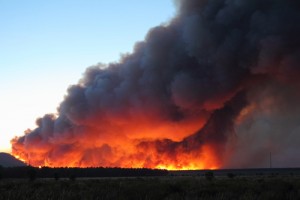 The policyholders owned a home with a detached garage in Alpine, Arizona. Beginning on May 29, 2011, eastern parts of the state and western New Mexico were devastated by a massive blaze known as the Wallow Fire – we published a post about an Arizona district court decision concerning business interruption loss that stemmed from that conflagration last month. The fire consumed the detached garage and all of the vegetation on the nearby hillside, but it did not reach the house. On August 6, 2011, however, one month after the Wallow Fire had been contained, there was a mudslide on the hillside, and mud and runoff water from flooding destroyed the home.
The insureds made claim under their homeowners policy. The carrier paid for the loss to the garage, but it denied the claim for the house because the contract of insurance expressly excluded loss attributable to:
Water damage, meaning any loss caused by, resulting from, contributed to or aggravated by . . . flood [or] surface water flooding; and
Earth Movement, meaning any loss caused by, resulting from, contributed to or aggravated by events that include, but are not limited to . . . mudslide
These exclusions were prefaced by ACC language reciting that the carrier did not cover loss “which would not have happened in the absence” of the excluded event “regardless of . . . the cause of the excluded event; . . . other causes of the loss; or . . . whether such causes acted at the same time or in any other sequence with the excluded event to produce or contribute to the loss.” Read more ›
 Instead of contending that the “requirements in case of loss” language mandated the tapes’ production, of course, the insurer should have sought them through regular discovery and moved to compel if they weren’t forthcoming. It is hard to see how the policyholder could have resisted that motion given her allegations of bad faith.
 Early last month a federal court in Indianapolis barred a policyholder from seeking the claims and underwriting files of the defendant carrier’s reinsurer in
  The insured owned a house and secured a homeowners policy that also extended coverage to his mortgagee. The mortgage company instituted foreclosure proceedings and the policyholder vacated the dwelling, but only after removing fixtures and damaging property to the tune of $246,025. The mortgagee’s subsequent insurance claim was denied, and litigation ensued.
 The Keystone State has not seen the dramatic uptick in earthquake activity that has shattered both nerves and property in Oklahoma in recent years. Because of the hydrocarbon-rich Marcellus Shale formation, however, it remains a jurisdiction with more oil and gas drilling than all but a handful of other states, and many homeowners have purchased earthquake endorsements in view of the widely-publicized rise in seismic activity in many such places.
  The property at issue was a former slaughterhouse in Askum that had been vacant since 2005. The policyholder (Brothers Future Holdings) acquired it in 2007 intending to use it for a contract cooking venture, but that business turned out to be stillborn. Property insurance was duly procured, based on an application reciting the structure was “100% owner-occupied.” The mortgagee came on board in August of 2007, and the insurer’s agent was contacted by the mortgage company and issued an “Evidence of Property Insurance” document to the mortgagee indicating that coverage was in place.
 Last month, we discussed a recent Texas Supreme Court decision that enforced an anti-concurrent causation (ACC) clause. The month of April also saw a unanimous panel on Iowa’s intermediate level appellate court do the same thing. In
  The policyholder White Mountain owned a hospital in Springerville, Arizona. On May 29, 2011, a blaze was started by an abandoned campfire in the nearby Bear Wallow Wilderness Area. The wildfire ultimately burned 841 square miles in eastern Arizona and western New Mexico, and it led to the temporary evacuation of Springerville. Residents weren’t allowed to return until June 13th, and the hospital itself was closed until the following day.
 On the TV show “Friends,” Phoebe Buffay used to entertain patrons at the Central Perk coffee shop with her song “Smelly Cat” (“Smelly cat, smelly cat, what are they feeding you, . . . “). The lyrics would have resonated with Doug and Gayle Mellin, the owners of a condominium in Epping, New Hampshire. After they moved in, the Mellins noticed a cat urine odor coming from a downstairs neighbor’s unit through an open plumbing chase in the kitchen wall. The stench was so severe that the town building inspector directed the couple to relocate temporarily and have the unit professionally remediated, but efforts to do that were unsuccessful. The policyholders vacated permanently after living there only three months.
 The policyholder owned The Pointe Apartments – a complex in Galveston, Texas that was heavily damaged when Hurricane Ike came ashore on September 13, 2008. Lexington afforded the primary layer of property insurance protection under a $25 million all-risk contract of insurance that covered dozens of local apartment complexes. Wind was not an excluded peril, and Lexington paid its building consultant’s estimate ($1,278,000) for the wind damage in full.